
Cats and dogs can coexist peacefully, but that outcome rarely happens by accident. When a dog’s energy, noise, and unpredictable movement fill a shared home, cats face a fundamentally different set of stressors than humans tend to notice. Hiding, house soiling, appetite loss, and overgrooming are all documented stress responses in cats — and they often get misread as behavioral problems rather than what they actually are: environmental ones. The good news is that most of the adjustments that make a real difference are structural, inexpensive, and don’t require any major renovation.
The Cat’s-Eye View of a Dog-Sharing Home
Cats are territorial animals whose sense of safety depends heavily on predictability and control over their space. Dogs disrupt both. Even a well-behaved dog that ignores the cat entirely changes the sensory environment: louder footsteps, unpredictable bursts of movement, different smells occupying shared rooms. Cats don’t habituate to these changes the way dogs do — they accumulate them as threat signals.
The single most effective shift a cat owner can make isn’t a product purchase — it’s rethinking vertical space. Cats instinctively move up when they feel threatened, and a home that only offers floor-level escape routes gives a stressed cat almost nowhere to go. Wall-mounted shelving designed for cats, or even a tall, stable cat tree positioned away from the dog’s usual pathways, can transform a cat’s experience of a shared room. Placement matters: within 3 to 5 feet of a wall or corner is preferable, since cats feel exposed when they can be approached from multiple directions simultaneously.
Equally important is the concept of “escape routes” at floor level. Furniture arrangement that allows a cat to move between rooms without being cornered — or without having to cross a dog’s resting spot — reduces anxiety significantly. A baby gate with a small cat-sized opening cut or built into the lower panel gives cats freedom of movement while keeping a large dog physically separated. These gates are widely available for under $40, and the access cutout can be added to most wooden gates with basic tools.
Rethinking Eating, Drinking, and Litter Placement
Stress-related appetite suppression is one of the first signs a cat isn’t coping with shared-home dynamics. If the food bowl, water source, or litter box is accessible to the dog — or even perceived as being in the dog’s territory — a cat may begin avoiding all three. The consequences of prolonged litter avoidance extend beyond carpet staining: urinary retention in cats can lead to blockages within 24 to 48 hours, a genuinely life-threatening outcome.
Feeding stations benefit from elevation as much as sleeping spaces do. A counter-height perch with the cat’s food and water, installed in a room where the dog doesn’t typically linger, removes the competition dynamic entirely. Microchip-activated feeders, which open only for a specific cat, solve the problem in multi-pet homes where dogs persistently investigate cat food — particularly relevant since many commercial dog foods and cat foods overlap in smell, and high-protein cat food consumed regularly by a dog can cause digestive and nutritional issues.
Litter box placement deserves specific attention. The standard guidance of “somewhere quiet” undersells how tactical this decision is in a dog-sharing home. The box should be:
- Positioned in a room where the dog can be reliably excluded, even temporarily, such as behind a cat door set into a laundry room or bathroom door
- Never placed in a corner with only one entry and exit point — cats avoid traps
- At minimum 20 to 30 feet away from the dog’s sleeping or primary resting area, since scent proximity alone can create avoidance
Sound, Scent, and the Less Obvious Stressors
Visual separation between a cat and dog gets most of the attention in multi-pet advice, but acoustic and olfactory stressors are equally real and significantly underaddressed. A dog barking at the mail carrier, a delivery notification, or another dog outside the window creates sudden, loud, unpredictable noise — exactly the sensory profile most likely to trigger a cat’s threat response.
Sound dampening doesn’t require soundproofing. Heavy curtains, rugs in hallways, and soft furnishings in a cat’s primary retreat zone all reduce sound transmission noticeably. Designating one room — even a small one — as a dog-free sanctuary where the cat can sleep and decompress gives the cat a baseline of predictability that offsets the unpredictability elsewhere in the home.
Scent management is subtler but worth addressing deliberately. Rotating which spaces the dog has access to, rather than allowing unrestricted whole-home access, gives cats areas where their own scent hasn’t been displaced. Pheromone diffusers designed specifically for cats — the synthetic analogs to feline facial pheromones — have enough research support to be used in veterinary clinic environments as a calming intervention. Placing one in the cat’s primary resting area and refreshing it every 30 days is a low-effort addition with a measurable effect on stress behaviors in cats sharing space with dogs.
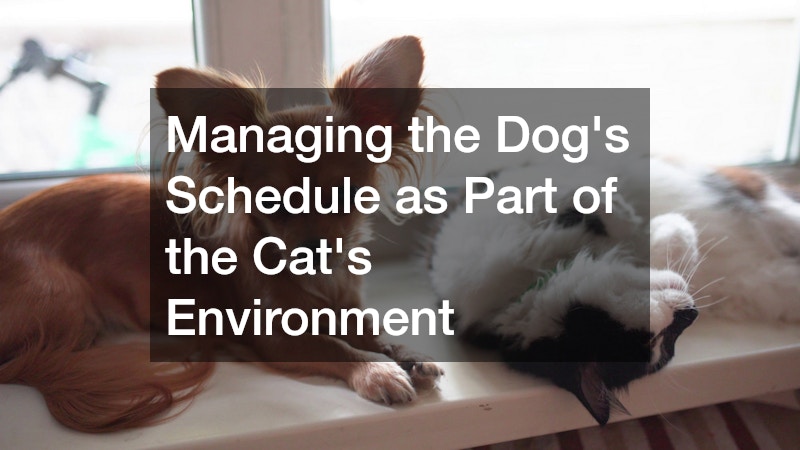
Managing the Dog’s Schedule as Part of the Cat’s Environment
One variable that significantly affects cat stress levels is how much predictability the dog’s schedule creates — or destroys. A dog that is home all day, active, and seeking interaction creates constant low-level pressure that accumulates over time. When owners work from home or otherwise have limited ability to structure the dog’s day, the cat absorbs that unpredictability directly.
Structured exercise and mental stimulation for the dog reduces the frenetic household energy that cats find most destabilizing. A dog that has been on a long walk, completed a training session, or been enrolled in doggy daycare on particularly high-energy days is considerably calmer at home — which directly benefits the cat’s ability to use shared spaces without feeling constantly on guard.
For dogs with very high energy output, a brief comparison of management strategies is useful. Outdoor exercise before the household’s peak activity period (typically 7 to 9 a.m.) tends to produce longer calm periods than afternoon activity. Mental enrichment — puzzle feeders, short training sessions — adds tiredness without escalating arousal the way rough play can. The goal isn’t to exhaust the dog but to reduce the unpredictable energy spikes that cats find hardest to adapt to.
Building a Calmer Home Without Starting Over
The changes that matter most for a stressed cat are rarely expensive or complicated. Vertical space, separated resources, acoustic softening, and a more predictable dog are the four levers that address the actual mechanisms of cat stress in a shared home — not surface-level adjustments but genuine environmental interventions. Start by observing where the cat currently spends most of its time and whether that location offers real safety: multiple escape routes, distance from the dog’s core territory, and access to food and litter without crossing high-traffic zones. That audit typically reveals the one or two changes that will have the fastest effect. Structural improvements compound over time — a calmer cat interacts more, hides less, and gradually becomes more tolerant of the dog’s presence rather than more sensitized to it.
